Chapter 12
Two Meanings of 3P
When people say “3P,” they usually mean Production Preparation Process: a structured way to prepare production by designing product and process in parallel. In this view, the operational process is treated as the primary “customer” of product development, because if the process is unsafe, unstable, or expensive, the business suffers no matter how clever the product is.
There is also a broader way to read 3P: Product, People, and Process. This lens reminds you that good production systems only succeed when they align with what customers value (Product), the skills and behaviours in the organisation (People), and how work is actually done (Process).
In this playbook, you mainly use 3P as Production Preparation Process, but the Product–People–Process view sits in the background whenever you think about design, flow, and launch.
Section 12.2
Set-Based Design: Work with Alternatives
In traditional projects, teams push hard to converge on one “best” solution early, then spend the rest of the time defending and patching it. 3P takes a different stance: it expects the first idea to be wrong or at least suboptimal, and it treats multiple alternatives as a normal part of design.
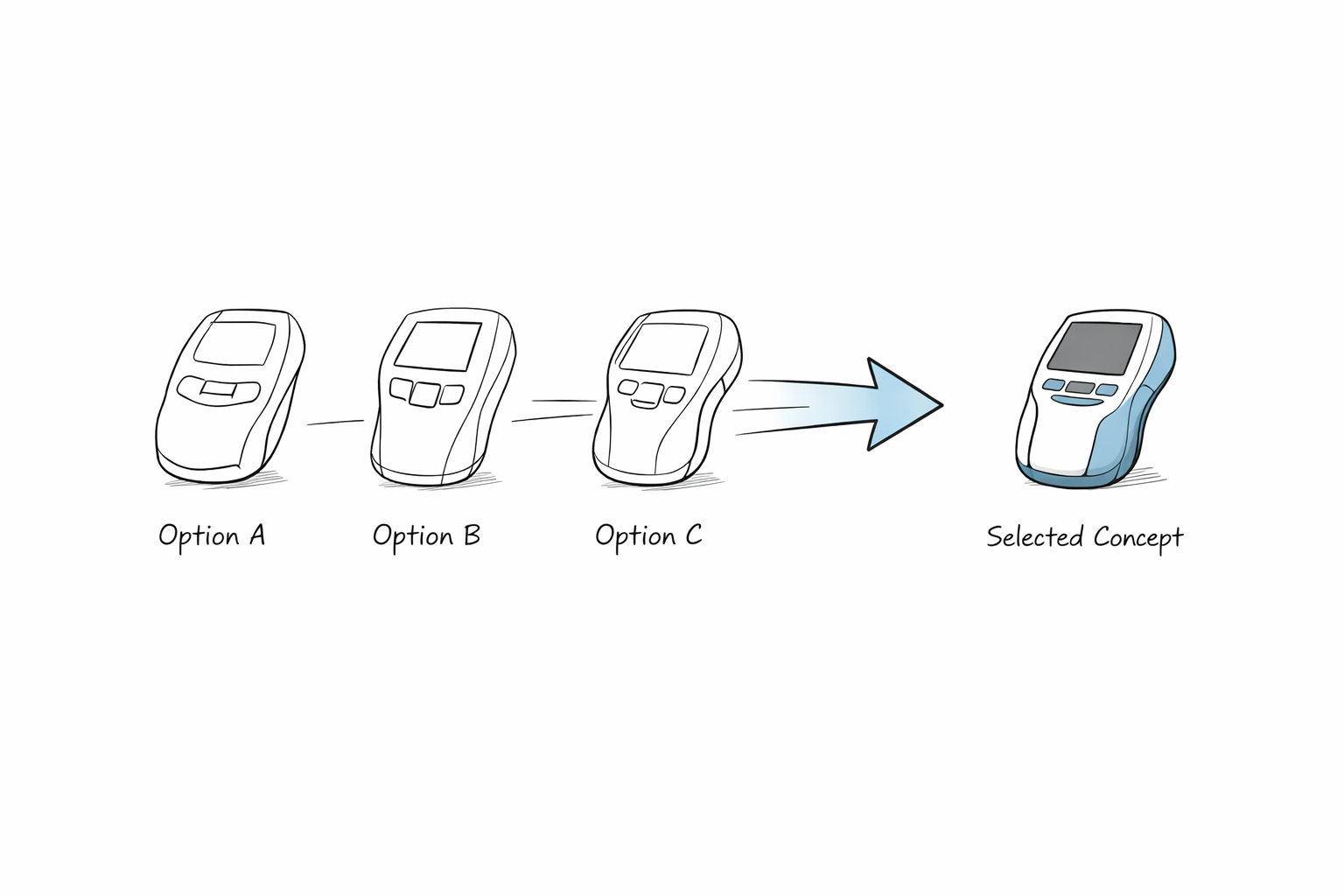
Set-based design means:
- You keep several product and process options open at the same time.
- You sketch and simulate different ways to achieve key functions.
- You narrow the set only as you learn which options are clearly better.
This shows up in tools like Quick-Look Value Engineering and 7 Alternatives, where the team is pushed to generate multiple options and then filter them with simple decision matrices instead of picking the first workable idea.
“The team that holds options open longest, while learning fastest, almost always builds a better system than the team that commits earliest.”
Section 12.3
Concurrent Product and Process Development
In many organisations, product development and process development are separate projects. Engineering “finishes” the design, then hands it to manufacturing to figure out how to build it. 3P treats this as a source of waste and risk.
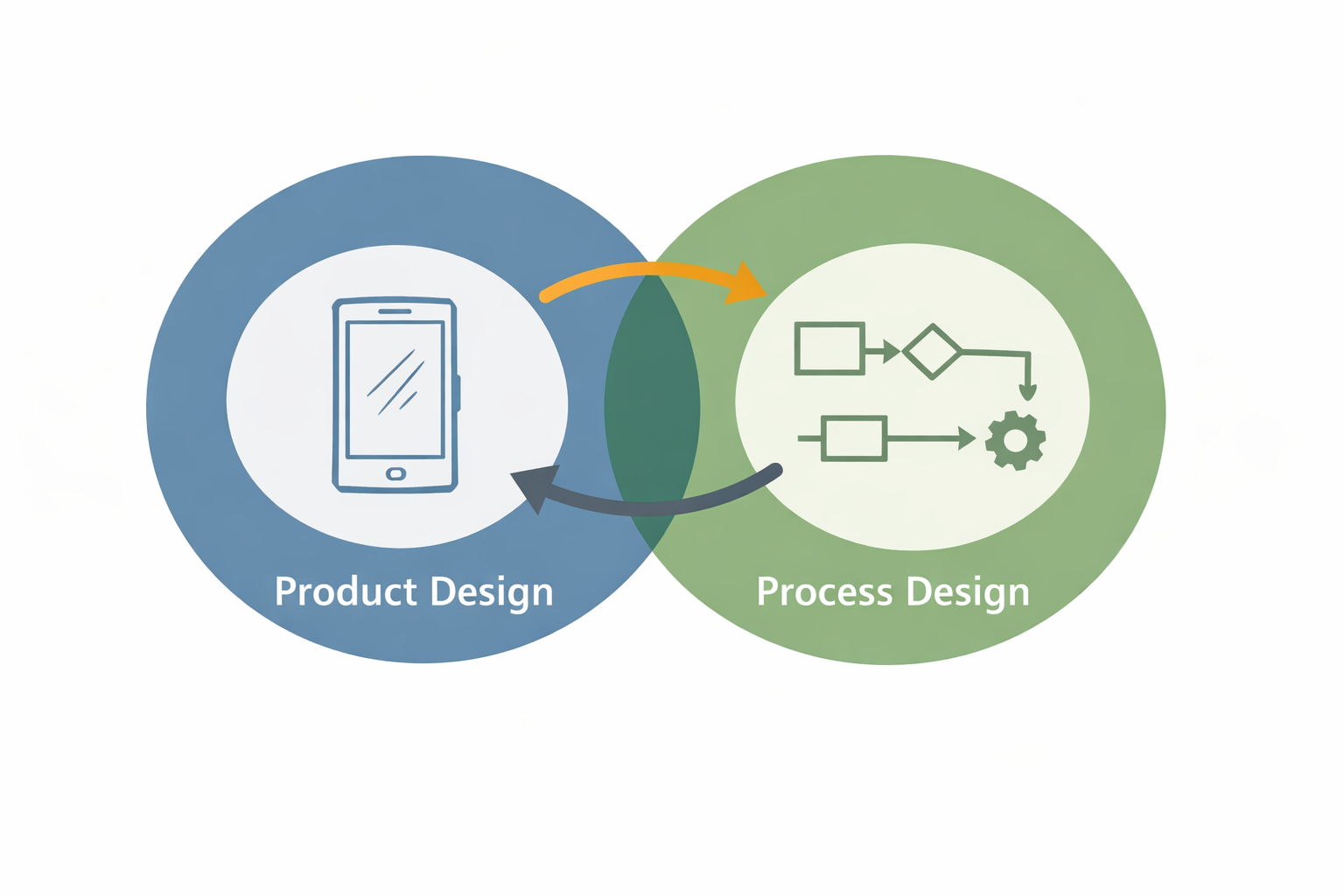
In Lean 3P:
- Manufacturing is involved early in product concept work.
- Product designers see real process constraints and cost drivers.
- Process designers influence choices around assembly sequence, tolerances, part count, and materials.
This concurrent development is why 3P uses events: Design 3P, Process 3P, and Production 3P bring cross-functional teams together at specific maturity points to work on the same problem from different angles. The three events are not separate initiatives — they are a connected flow.
Section 12.4
Delay Decisions, Not Learning
Another mindset shift in 3P is the idea of delaying commitment without delaying learning. Instead of deciding early and learning later, you aim to learn early and decide when you have enough evidence.
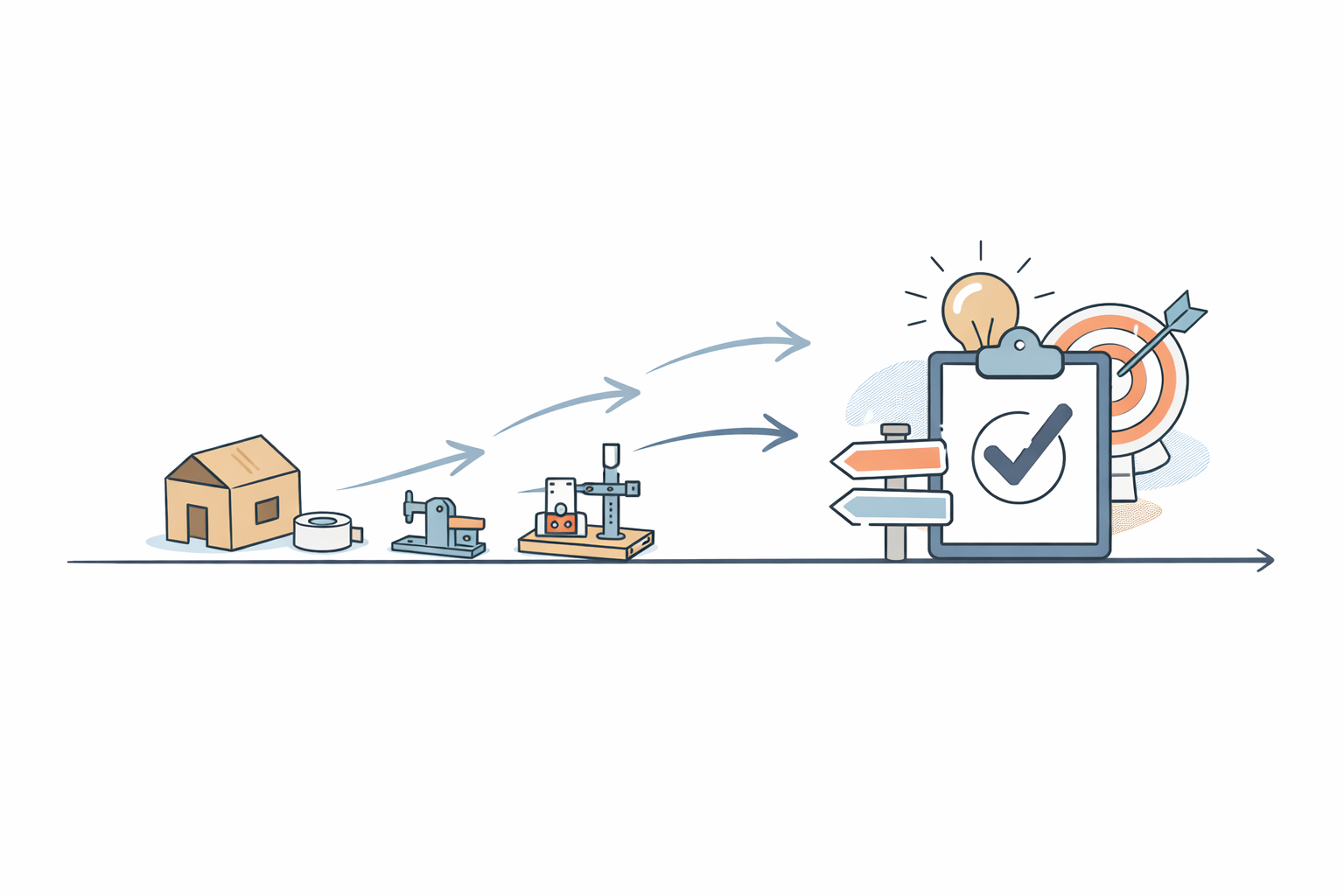
In practice, that means:
- Delaying concept and detailed design freeze as long as you can still influence cost.
- Using cardboard mockups, benchtop simulations, and simple models instead of early capital purchases.
- Committing to tooling, layout, and automation only after simulations and trial builds show that the process works.
This is the logic behind vertical start-up in Production 3P: you ramp up in stages, learning and stabilising at each phase instead of trying to switch everything on at once. The goal is a smooth, predictable ramp — not a “big bang” launch that discovers problems at the worst possible moment.
Section 12.5
Operator as Surgeon
A defining mindset in 3P is that the operator is the surgeon and the product is the patient. Everything else exists to support the operator in doing value-adding work.
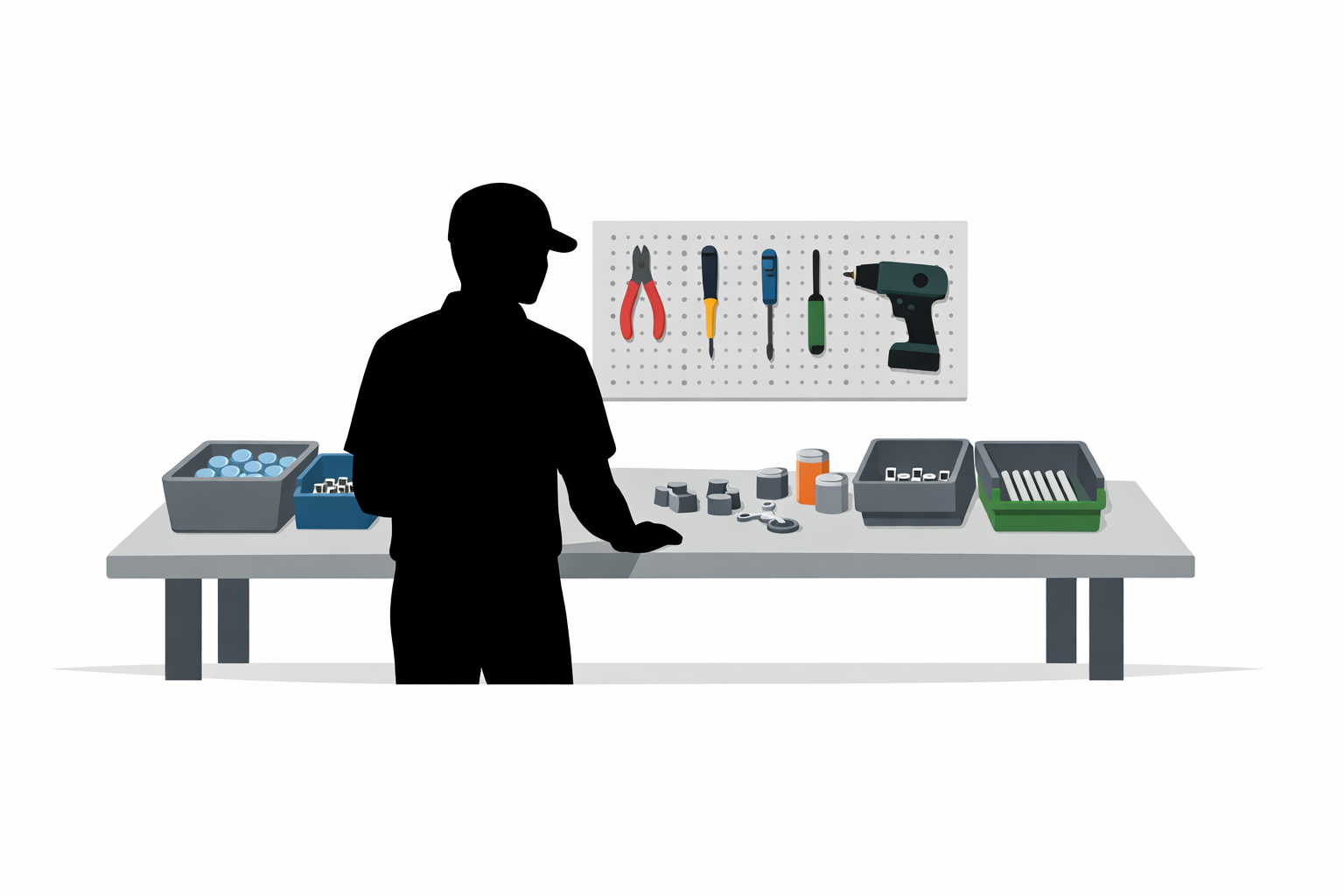
That translates into simple rules:
- The operator should not leave the workstation to search for parts, tools, or information.
- Material, tools, and information come to the operator in the right quantity, sequence, and orientation.
- Every second spent on anything other than value-adding work is treated as waste.
This mindset shapes many of the plays in Chapters 14–16: how layouts are drawn, how PFEP and water spider routes are designed, how information flow and standard work are created, and how quality is built into the process rather than inspected at the end.
Section 12.6
What This Philosophy Means for the Rest of the Book
The rest of this volume turns these four ideas into concrete plays and tools. Understanding the philosophy makes the plays easier to adapt when your situation does not fit the textbook case exactly.
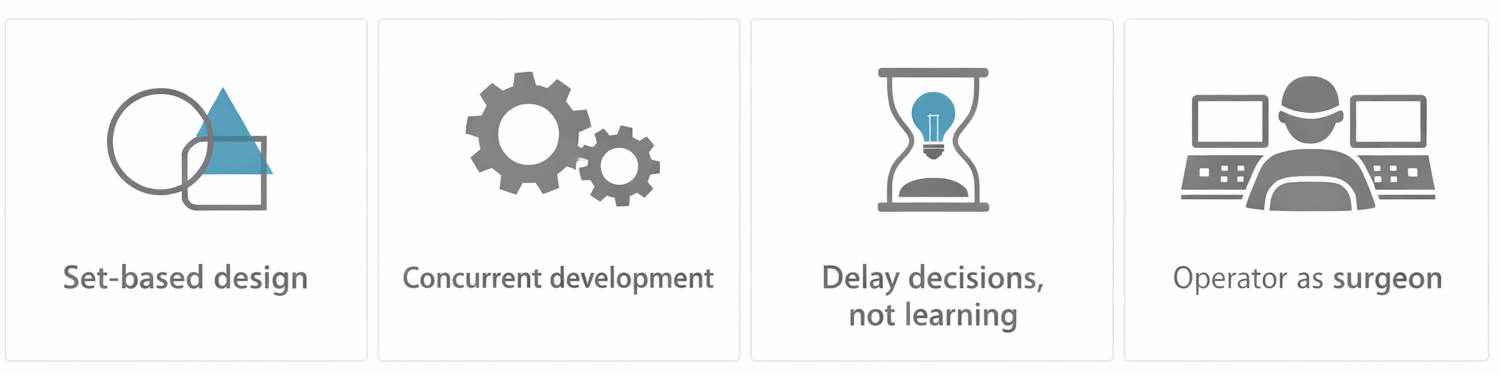
Set-Based Thinking
Drives Quick-Look & 7 Alternatives
In Design and Process 3P, the team generates multiple options and filters them with decision matrices — never committing to one solution too early.
Concurrent Development
Shows up in cross-functional events
The three 3P events bring product, process, and production teams together at the right moments — and the outputs of each feed directly into the next.
Delay Decisions, Not Learning
Underpins event timing & mockups
How you schedule events, use cardboard mockups, and design vertical start-up all follow from this principle: learn first, commit when you know enough.
Operator as Surgeon
Shapes layout, PFEP & standard work
In Production 3P, every layout decision, material flow choice, and standard work sheet is tested against one question: does this help the operator do value-adding work without interruption?
Chapter 13 will now connect this philosophy to the four phases and three events of a 3P program, before Chapters 14–16 walk through each event in detail.