Chapter 13
From Idea to Ready-to-Run
A Lean 3P effort moves through a small number of phases as the product and process mature, and it uses three key events to accelerate learning at the right moments. This chapter gives you that overview: the four phases of a 3P program and the three core 3P events that bring those phases to life.
The purpose is to help you see where you are in the industrialization journey and which kind of work makes sense next. Instead of treating every situation as a generic “3P workshop,” you can use the phase and event model to choose the right play: understanding context and constraints, generating alternatives, designing the value stream, or getting ready for start-up.
Section 13.2
The Four Phases of a Lean 3P Program
Think of a 3P program as moving through four overlapping phases as your solution matures. In reality, you will move back and forth as you learn. The phases are guides to help you see how early decisions affect later freedom to improve, not rigid boxes.
Phase 1
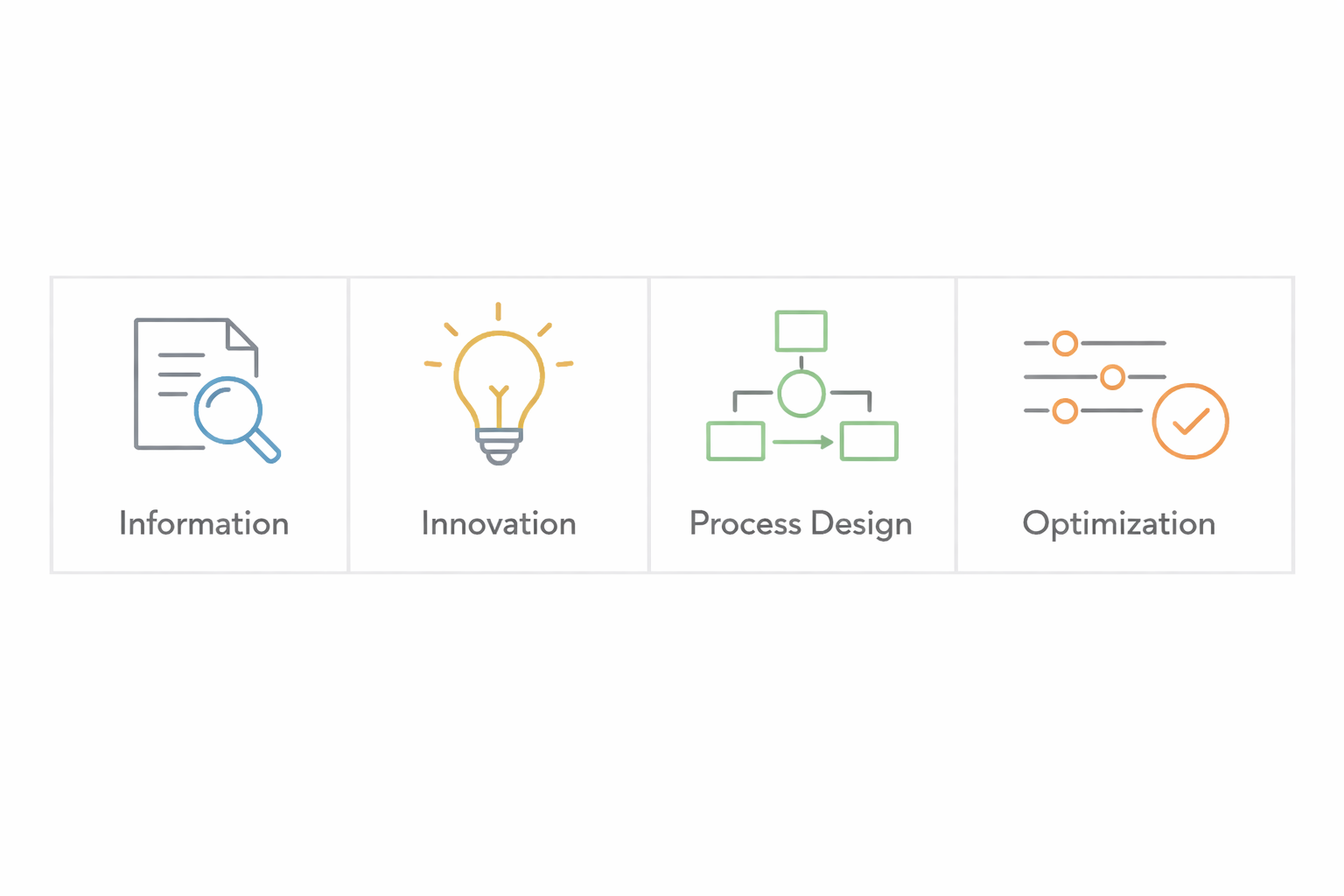
Information
Collect historical production and quality data from similar products or processes. Clarify projected volumes, takt time, space constraints, and capital budgets. Sketch an initial high-level manufacturing plan. The goal is to understand the problem and context well enough that later design and event work rests on real conditions, not guesses.
Phase 2
Innovation
Identify critical cost and quality drivers (CTQ/CTC). Generate multiple alternatives for key design elements and process steps. Use tools like Quick-Look and 7 Alternatives to explore and rank options. Here you are deliberately widening the design space before committing, using set-based thinking to reduce risk.
Phase 3
Process Design
Design, simulate, and refine a conceptual line or value stream. Build mockups, run SORK cycles, and design supporting systems (material, information, maintenance). Begin specifying equipment, fixtures, and layout at a practical level. The focus is on how material and information will flow end-to-end, not on individual machines in isolation.
Phase 4
Optimization
Finalize product and process details in parallel, smoothing the launch. Prepare production readiness: PFEP, training plans, standard work, and trial builds. Execute vertical start-up and move toward stable rate production. This is where you tune the system under real conditions and close remaining gaps before full-scale operation.
Section 13.3
The Three Core 3P Events
To make these phases actionable, 3P anchors work in three core events, each at a specific maturity point in development. These events are not meetings — they are concentrated learning and design efforts where cross-functional teams move the system forward in big steps.
Event 1
Design 3P
Timing: ~70–80% concept completion, before concept freeze
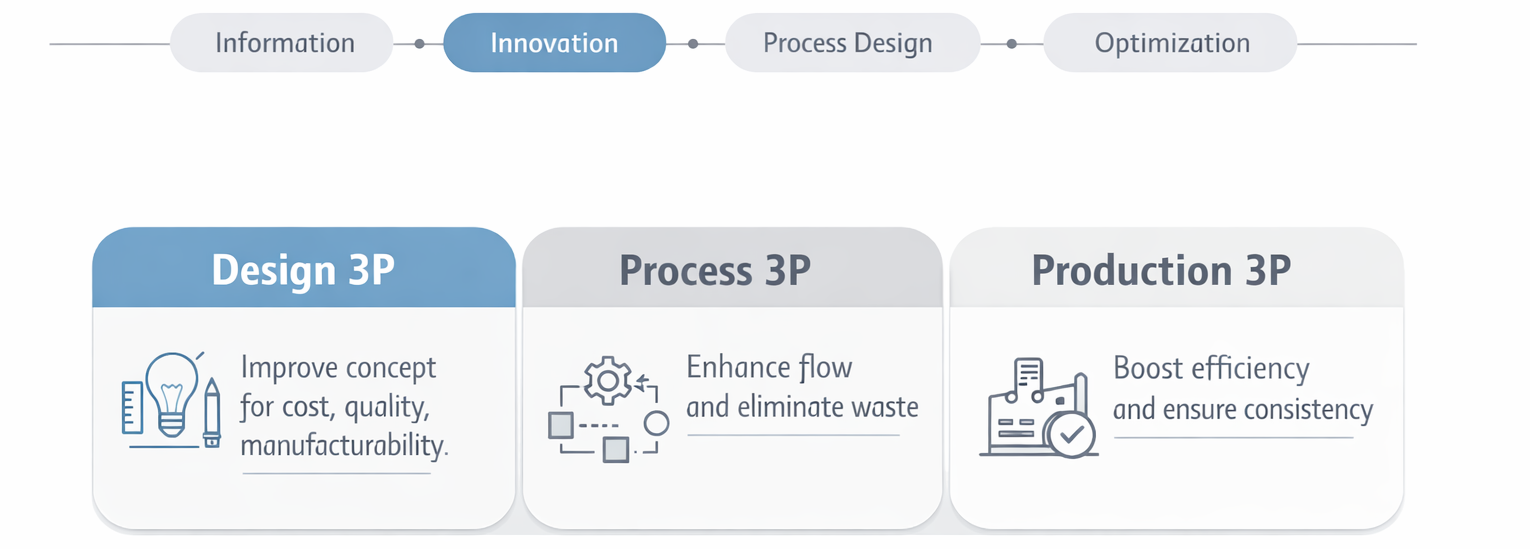
Focus: product concept, CTQ/CTC opportunities, manufacturability. Key outputs: prioritised CTQ/CTC list, selected alternatives from Quick-Look, refined manufacturing concept. Design 3P sits mainly in the Innovation phase, using early knowledge to improve the concept while changes are still cheap.
Event 2
Process 3P
Timing: late in detailed design, before process and tooling choices are locked
Focus: internal and external value streams, high-impact process steps, 7 Alternatives, flow and capital optimisation. Key outputs: current and future-state value stream maps, shortlisted process alternatives, draft production plan. Operates in the Process Design phase.
Event 3
Production 3P
Timing: pre-launch, often as a series of mini-events
Focus: layout, PFEP, water spider routes, information flow, readiness checks, and pilot builds. Key outputs: tested line or cell, production readiness checklist, vertical start-up plan. Spans the late Process Design and early Optimization phases, turning plans and mockups into a ready-to-run system.
Section 13.4
How Phases and Events Fit Together
Seen as a whole, the four phases and three events form a coherent industrialization flow. Each phase creates the conditions for the events, and the outputs of each event feed the next phase.
- The Information phase sets the stage for all three events by grounding the work in real demand, constraints, and history.
- The Innovation phase is where Design 3P lives: surfacing CTQ/CTC issues, exploring alternatives, and refining the manufacturing concept.
- The Process Design phase is where Process 3P does most of its work, designing value streams and making smart process and capital choices.
- The Optimization phase is where Production 3P ensures that layout, material flow, information flow, and people readiness come together for a smooth start-up.
“The phases and events give you a simple diagnostic: if you do not yet know which phase you are in, that is the first problem to solve before scheduling any 3P event.”
A practical diagnostic
This flow sets up the deeper chapters that follow: Chapter 14 dives into Design 3P, Chapter 15 covers Process 3P, and Chapter 16 addresses Production 3P and vertical start-up in detail.