The inherited process problem
Why one process option is not enough
In Lean 3P, we want to design product and process together early enough that major decisions are still flexible. But under time pressure, most organisations default to the safest-feeling option: existing machines, familiar tooling, and layouts that mirror what was done before. The first idea becomes the only idea.
That habit has a direct cost. Capital is locked into suboptimal equipment and fixtures chosen by familiarity rather than fit. Complexity and quality problems are baked in at the design stage rather than being surfaced and removed. Operations teams are left fighting waste after launch instead of preventing it through better upfront design.
The Seven Alternatives Play aims directly at this. It makes “at least seven different ways to do this” the required starting point for any high-impact process step — before large investments are made, and while the team still has genuine freedom to choose.
“The first idea is rarely the best one. The play forces teams to push past the familiar before committing to anything.”
The play defined
What the Seven Alternatives Play is
The Seven Alternatives Play is a structured creativity exercise used in Lean 3P events and process design work. Its purpose is to dramatically widen the option set before any evaluation or commitment happens.
- At least seven ideas per critical step. The number is deliberate. The first few ideas are usually obvious. Real creativity tends to emerge around idea four, five, six, and seven, when teams have exhausted the obvious and are forced to think differently.
- Visual ideas, not just descriptions. Teams sketch options rather than talking about them. Even rough drawings make it easier to compare, combine, and build on what others propose.
- Clustering into themes. After brainstorming, ideas are grouped using an affinity-style approach. This helps teams see families of options — different automation strategies, different flow patterns, different fixturing principles — rather than a random list of suggestions.
- Quick comparative evaluation. Promising options are compared against the current process and against each other using simple trade-off criteria. The goal is not a perfect model; it is a fast, honest signal about which directions deserve deeper exploration.
The play does not replace full Lean 3P design work. It strengthens the front end: making sure that when the team moves into detailed concept development, it is working from a genuinely broad set of options rather than a dressed-up version of the status quo.
Right time, right place
When to use it
The Seven Alternatives Play is most valuable when the decision in front of you will lock in cost, complexity, or flexibility for a long time. Not every process step warrants this level of attention — use it selectively.
- Process steps with significant capital cost: tooling, custom fixtures, dedicated equipment.
- Steps with known or recurring yield, quality, or safety issues that kaizen has not resolved.
- New line or cell design as part of a 3P programme or major industrialisation effort.
- Situations where the team has defaulted to the same approach on two or more previous products.
If the step is low-cost and reversible, a lighter approach is fine. Reserve the Seven Alternatives Play for the decisions that, once made, will shape the line for years.
Running the workshop
How to run a Seven Alternatives workshop
The workshop can be run in a half day with good facilitation. Keep the agenda light; the group will naturally find the biggest opportunities if the right people are in the room and the challenge is clearly framed.
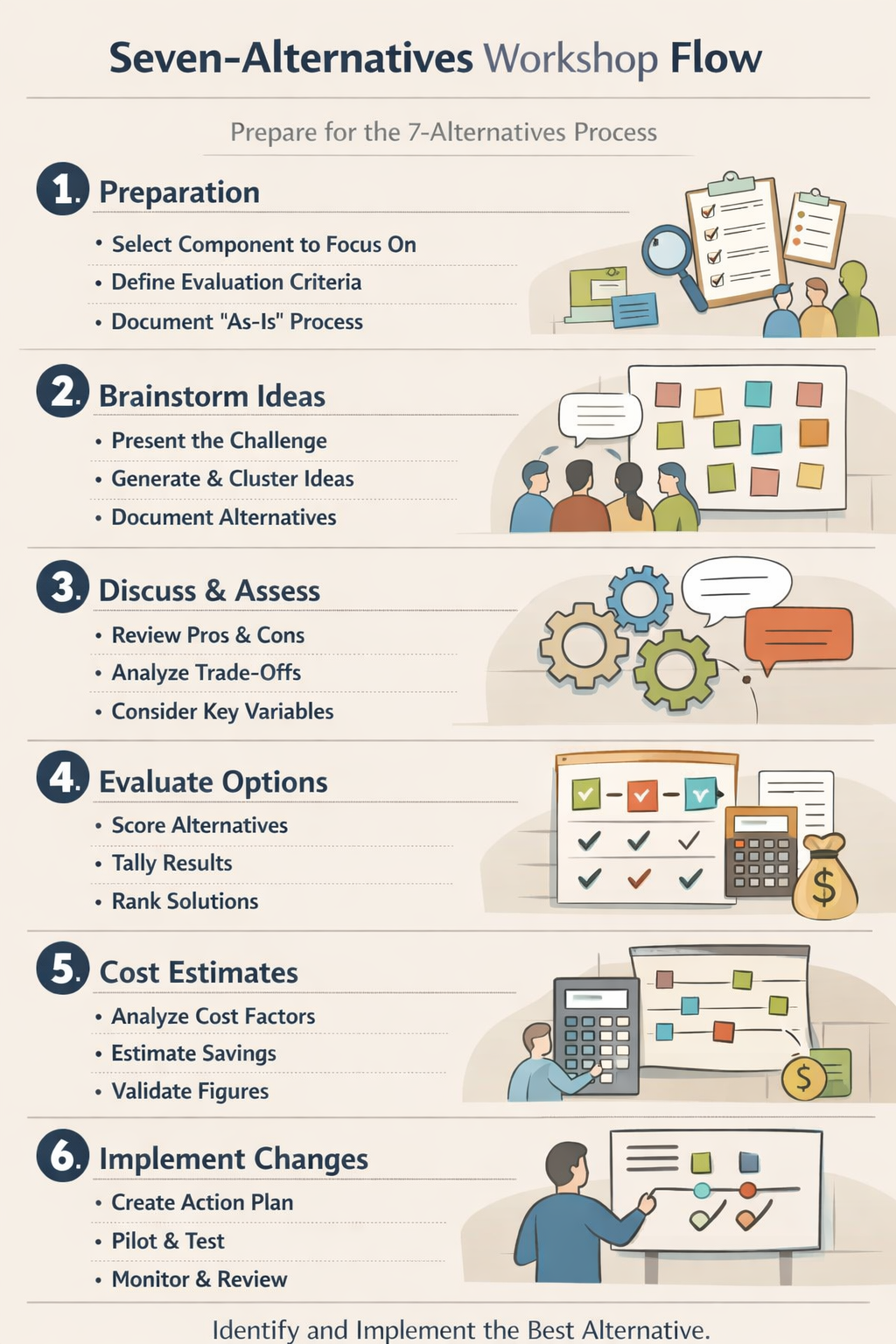
- Select a component or process step with significant impact on cost, complexity, or yield.
- Define a short list of evaluation criteria you will use later: for example, capital cost, labour content, quality or yield, flexibility, and footprint.
- Document the current “as-is” process and its key trade-offs. This becomes the baseline in all later comparisons.
- Assemble the right team: people who know existing processes well, and people who understand alternative technologies. If no one in the room has heard of an option, it will not appear on the list.
- Present the challenge clearly, even if the same people helped with preparation — framing it as a shared problem rather than a given direction matters.
- Run fast, time-boxed brainstorming (three to five minutes) to generate ideas individually on sticky notes or cards before sharing.
- Encourage everyone to push past their first two or three obvious ideas. The constraint of reaching seven forces this.
- Have participants sketch their ideas wherever possible; even a rough diagram communicates more than a label.
- Ask participants to place their notes on a shared wall or board without filtering.
- Group similar ideas together into clusters; let new variations or combinations emerge as people see each other’s proposals.
- Capture each distinct alternative in a simple one-page or card template so it can be compared in the next step.
From options to direction
Evaluating and choosing alternatives
Once you have a set of alternatives, you want a fast, honest way to compare them against the baseline and against each other — without false precision at a stage where data is still approximate.
For each alternative, hold a short informal discussion: what are the main pros and cons? What are the key trade-offs — automation versus manual, standard versus custom fixtures, dedicated versus flexible methods? Keep it moving; the aim is honest insight, not a complete analysis.
Using your agreed criteria, rate each alternative relative to the current process:
- + if better than the baseline on this factor
- – if worse
- S if roughly the same
Tally the results. This gives a fast, visible signal of which alternatives look genuinely promising and which can be set aside without detailed analysis.
A Pugh matrix is a natural next tool: it compares options against a baseline qualitatively, forces a conversation about trade-offs, and avoids false precision when data is still approximate. Use the same criteria. Keep scales simple and consistent with the information available at this stage.
- Assign someone to gather rough cost and risk data for the two or three alternatives that clearly outperform the baseline.
- Consider both non-recurring costs (engineering, tooling, installation) and recurring costs (labour, materials, scrap, maintenance, wear).
- Do not chase exact figures at this stage. The goal is to distinguish “roughly the same” from “clearly better or worse.”
- If two options look similar in cost and risk, prefer the one with lower reversibility risk or greater flexibility. Validate key assumptions with finance and operations before committing.
“The scoring step is not about picking a winner. It is about making the conversation concrete enough that the team stops defending and starts comparing.”
Closing the loop
From alternatives to action
The play ends by turning the best option or options into a concrete next step — not a final decision, but a commitment to learn more in a controlled way.
- Agree which option or options to prototype or pilot. Be specific: who owns it, what the pilot will test, and what “good enough” looks like.
- Define a simple learning plan: roles, milestones, and the two or three metrics that will tell you whether the alternative actually performs as expected.
- Run the pilot in realistic conditions. Cardboard, mock-up stations, or early tooling trials all work at this stage.
- Adjust the process design and cost picture based on what the pilot reveals. Feed the results back into the 3P programme.
The Seven Alternatives Play does not guarantee the right answer. It guarantees that the team has genuinely looked for one — which is a significantly better position than committing to the first option that felt familiar.
Next steps
Put this into practice
Use this play before committing major capital to any process step in a Lean 3P effort. Start with one component or operation where cost, quality, or complexity are chronic problems. Run a half-day Seven Alternatives workshop, then take the top two or three options into deeper 3P design and cost analysis. The play works best as part of a broader 3P event, but it can also be run as a standalone session for a single high-stakes step.
Chapter 11
Why Lean 3P?
The launch problems that make early process design essential, and what Lean 3P does differently.
Chapter 15
Process 3P
Finding high-impact steps, running seven alternatives, and building the future-state production plan.
Chapter 5 • Section 5
Integrating Manufacturing & Operations Early
How to bring operations into product design early enough that alternatives are still available to choose from.