Starter Kit · Lean 3P
Lean 3P Starter Kit
A practical guide to Production Preparation Process for product and manufacturing teams.
Learn the method. Run your first Design 3P event. Two free downloads — no sign-up required.
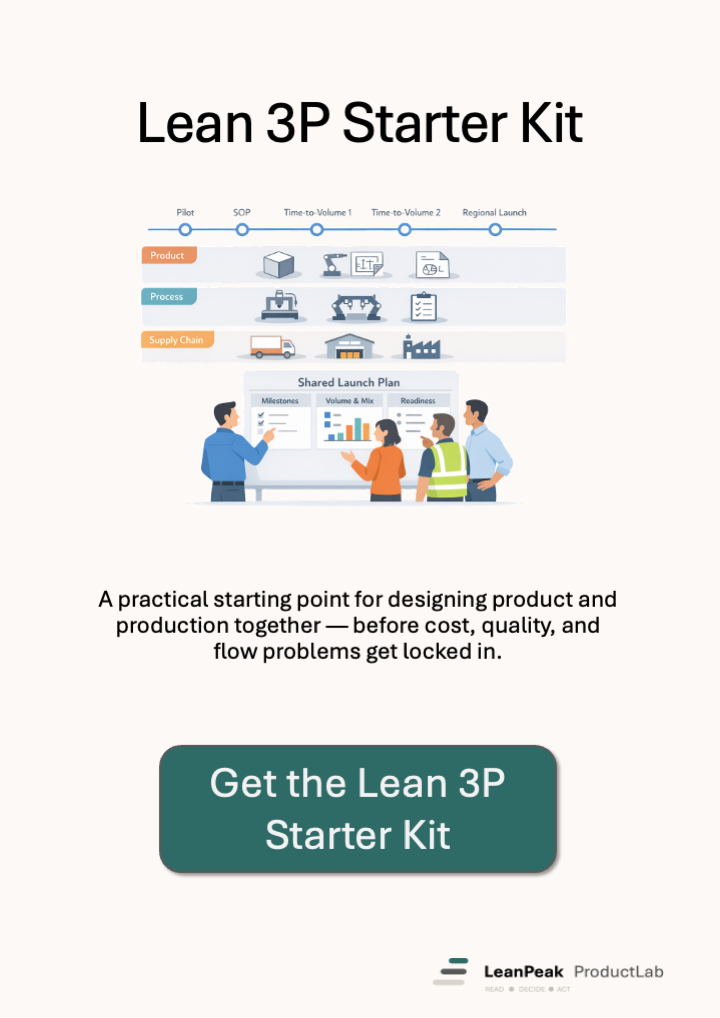
Main download · PDF
Lean 3P Starter Kit
The complete guide: what Lean 3P is, when to use it, how to think about Design 3P, and how to run your first event. Worked examples included.
Free · No sign-up required
Companion download · Excel
3P Templates Toolbox
Seven ready-to-use working sheets for your first Design 3P event: CTQ/CTC analysis, decision matrix, value stream maps, knowledge gap log, action sheet, and 7 alternatives matrix.
Excel · Free
Why it matters
Most production problems are design problems in disguise
Production launches are harder than they need to be. Parts that can’t be assembled without rework. Process steps that require operator heroics to hit takt. Quality problems that trace back to design decisions made months before anyone thought about the production line.
The root cause is usually the same: product design and process design were done separately, in sequence. By the time production engineering sees the design, architectural decisions are locked in. The only options left are workarounds — not solutions.
Lean 3P (Production Preparation Process) breaks this pattern. It brings product designers, process engineers, and operators into a shared event early enough to change what gets built — before tooling is committed and capital is spent.
When to use it
Lean 3P is the right tool when the stakes are high and options are still open
Lean 3P is not a tool for every situation. It delivers the most value when product and process design are still converging — and when the cost of a wrong decision is high.
- You are designing a new product for production and want to avoid late-cycle buildability problems
- You are introducing a new production line or process and need to evaluate alternatives before capital is committed
- A current product has chronic quality, flow, or assembly problems that trace back to design
- A product requires significant cost reduction before the next generation
- You are planning a major capital investment and want to build and test process concepts first
- You are using Lean Learning Cycles and need a structured event to explore process alternatives
If design decisions are already locked and tooling is committed, 3P is too late. Use kaizen or focused improvement instead.
How it thinks
Four ideas behind Lean 3P
Lean 3P is not just a workshop format. It is a different way of thinking about the relationship between product design and production design. These four ideas underpin everything else.
1
Design and process belong together
Product design and process design should be developed concurrently, not sequentially. Decisions about what to build and how to build it interact — and are best made together, by the same people, in the same room.
2
Keep options open until you have knowledge
Commit to a single concept only when you have enough evidence to make a good decision. Running multiple alternatives in parallel — set-based thinking — keeps the design space open until you know which direction is right.
3
Operators are co-designers, not reviewers
The people who will build and run the process have knowledge that designers don’t. Bringing operators, technicians, and production engineers into the design event is not courtesy — it is how you get designs that can actually be built.
4
Build and test before committing capital
Before tools and fixtures are ordered, build and test simple process models. Cardboard mockups, paper layouts, bench tests. The goal is to answer questions with physical evidence before the cost of change becomes prohibitive.
The path
The Lean 3P path
Lean 3P runs through the four-phase industrialisation flow. Each phase has its own focus and events. Design 3P comes first, which is why it is the right starting point for a first project.
Phase 1 & 2
Design 3P
Identify buildability risks. Explore design alternatives. Align on CTQ/CTC priorities before architecture is locked.
▶ Start herePhase 2 & 3
Process 3P
Map the value stream. Find high-impact process steps. Run seven alternatives to identify the best process concept.
Phase 3
Production 3P
Define the layout, material flow, standard work, and poka-yoke. Prepare for a vertical start-up.
Phase 4
Vertical Start-Up
Launch with a short ramp, structured learning, and optimisation events before committing to full rate.
Where to begin
Start with Design 3P
Design 3P runs during the product concept and early design phase — before architectural decisions are locked in. Its purpose is to identify which design features create the most buildability and producibility risk, and to explore alternatives before committing to a direction.
The key questions Design 3P answers:
- Which CTQs (Critical to Quality) and CTCs (Critical to Cost) carry the highest manufacturing risk?
- Where are the design features most likely to cause assembly problems, quality issues, or high cost?
- What alternatives exist for the highest-risk elements — and which are worth exploring further?
- What does the value stream look like for this product, and where are the likely constraints?
- What do we not yet know, and how will we find out?
Design 3P does not require a finished design. It works best when the design is still in concept form — when there is still room to change the architecture, the materials, and the assembly approach based on what you learn.
Getting ready
Prepare your first Design 3P event
A Design 3P event needs modest preparation. One to two weeks of focused work is usually enough for a first event. The goal of preparation is to arrive with the right people, the right information, and a shared understanding of what the event is trying to achieve.
Before the event
- Identify the product or product family this event is for
- Confirm the top CTQ and CTC requirements (or draft them)
- Gather current design documentation — drawings, BOM, early concepts
- Sketch a rough value stream for this product (internal and external)
- Brief the management sponsor on the event purpose and expected outputs
- Set a clear event purpose and what decisions you want to be able to make afterwards
Who to invite
- Product designer / design engineer
- Manufacturing / process engineer
- Quality engineer
- Operator or production technician
- Supply chain or procurement representative
- Management sponsor (for the opening and closing)
- Lean coach or facilitator (for the first event)
A simple agenda
A one-day Design 3P event
A full Design 3P programme typically runs over two to three days. For a first event or a focused product review, a single structured day can deliver significant value. The agenda below follows the natural flow from understanding requirements to identifying opportunities to agreeing actions.
Opening: Why this product, why now
Management sponsor sets context. Team aligns on the event purpose and the decisions they want to be able to make by the end of the day.
Session 1 — CTQ/CTC review
What must this product do, and what must it cost to build? Team reviews and scores the top CTQ and CTC items. Identify the highest-risk areas using the CTQ/CTC Opportunity Sheet.
Session 2 — Quick-Look opportunity scan
For the top 2–3 CTQ/CTC hotspots: decompose each into functions, generate concept alternatives, and compare against the baseline using the Quick-Look Decision Matrix.
Lunch break
Session 3 — Value stream walk
Sketch the external and internal value stream for this product. Where will it come from, how will it flow through the plant, and where are the likely bottlenecks and quality risks? Use the Value Stream Map sheets.
Session 4 — Knowledge gap log
What do we not yet know that matters? Capture open questions with an owner and a target date. These become the inputs for Learning Cycles and follow-up 3P events.
Short break
Session 5 — Action planning
Complete the Design 3P Action Sheet. Agree on the top three opportunities found, concept changes to explore, and manufacturing implications. Assign owners and due dates.
Closing: Next steps and sponsor debrief
Present outputs to management sponsor. Agree on what happens next: follow-up learning cycles, a second 3P event, or design changes to explore. Close.
Expected outputs
What good output looks like
A well-run Design 3P event does not produce a thick report. It produces a small set of clear, actionable outputs that the team can act on immediately.
Prioritised CTQ/CTC list
The top buildability risks scored and ranked. Everyone agrees on which items need attention first.
Concept alternatives
2–4 design or process concept alternatives for the highest-risk elements, ready for further evaluation.
Draft value stream maps
A first sketch of the external and internal value stream — enough to see the flow and spot the constraints.
Knowledge gap log
Open questions with owners and target dates. These feed directly into follow-up learning cycles.
Design 3P Action Sheet
A clear list of follow-on actions, owners, and due dates. The team knows what happens next before leaving the room.
Shared understanding
Design, process, and operations leave with a common picture of the risks and the plan. That alignment is itself an output.
What comes next
How Design 3P feeds the rest of the programme
Design 3P is the starting point, not the whole programme. Its outputs become the inputs for the next phases.
- CTQ/CTC priorities → Process 3P. The highest-risk design elements become the focus for process design. The 7 Alternatives Matrix explores process concepts for each high-impact step before capital is committed.
- Value stream maps → Process 3P. The draft maps from Design 3P are developed into full current-state and future-state maps that drive layout and flow decisions in Process 3P.
- Knowledge gaps → Learning Cycles. Every open question in the Knowledge Gap Log becomes a candidate for a Lean Learning Cycle — a structured experiment to answer the question before the next decision gate.
- Concept alternatives → Production 3P. The design and process alternatives selected after Design 3P and Process 3P feed directly into the layout, material flow, and standard work design in Production 3P.
Running Design 3P first means you have the right problem defined before spending time on process design. Teams that skip it tend to design processes for the wrong product.
The toolbox
What’s inside the 3P Templates Toolbox
The 3P Templates Toolbox is a companion Excel file with ready-to-use working sheets. Print them, share them digitally, or adapt them for your own process. They are designed to be used during the event — not filled in afterwards.
CTQ / CTC Opportunity Sheet
Identify and score Critical-to-Quality and Critical-to-Cost items. Rank by impact and ease to find the highest-priority opportunities for Design 3P attention.
Quick-Look Decision Matrix
Run a fast value-engineering cycle on a high-priority design element. Decompose it into functions, generate alternatives, and compare them against the baseline using a simple + / S / – scoring grid.
External Value Stream Map Sheet
Map the supply-side flow: suppliers, parts, lead times, batch sizes, delivery frequency, and reliability risks. Identify which external flows are most likely to constrain the internal design.
Internal Value Stream Map Sheet
Map the internal production flow: process steps, cycle times, lead times, operators, queue sizes, and quality issues. Identify bottlenecks and waste before the line is designed.
Knowledge Gap Log
Capture what the team does not yet know. Each gap gets an owner and a target date. Gaps without owners stay open — this sheet makes that visible and forces resolution.
Design 3P Action Sheet
Capture the top opportunities found, example concept changes, key manufacturing implications, and follow-on actions with owners and due dates. The closing output of every Design 3P event.
7 Alternatives Matrix
For Process 3P: compare a baseline process plus at least six alternative process concepts for a high-impact step before capital is committed. Score each against trade-off criteria and build a shortlist.
Getting started
Start with one real product
The best way to learn Lean 3P is to run it on a real project with real stakes. Not a pilot with a toy problem — a real product, a real team, and a real decision to be made.
Pick one product where buildability risk is high and architectural decisions are still open. Invite five to eight people who together cover design, process, quality, and production. Book a day. Use the tools in the Toolbox. See what you find.
One focused Design 3P event often surfaces more buildability risk in a day than six months of individual design reviews. The insights are already in the room — the event just creates the conditions for them to surface.
Download 1 of 2 · PDF
Lean 3P Starter Kit
The complete field guide. Read it before the event. Share it with your team. Use it to prepare and facilitate your first Design 3P event.
Free · No sign-up required
Download 2 of 2 · Excel
3P Templates Toolbox
Seven working sheets for the event: CTQ/CTC, decision matrix, value stream maps, knowledge gap log, action sheet, and 7 alternatives matrix. Print or use digitally.
Excel · Free