The starting point
Why scientific thinking matters in development
Traditional product development often treats uncertainty as something to be pushed aside quickly. Teams feel pressure to lock requirements, freeze architectures, and “get going” long before they fully understand customer needs, technical limits, or flow constraints. That approach can feel fast in the beginning, but it typically shifts risk downstream into late changes and rework.
Scientific thinking offers a different pattern. Instead of pretending uncertainty is small, it treats uncertainty as the main material of early development. Teams observe, frame problems explicitly, formulate hypotheses, run experiments, analyse what happened, and then adjust. This cycle repeats as designs and knowledge mature.
In Lean Product & Process Development, this is not an academic exercise. It is the core of how teams learn early enough to influence architecture, process, and launch decisions.
“Scientific thinking treats uncertainty as the main material of early development — not as a problem to be pushed past.”
The core loop
The scientific model as a product development pattern
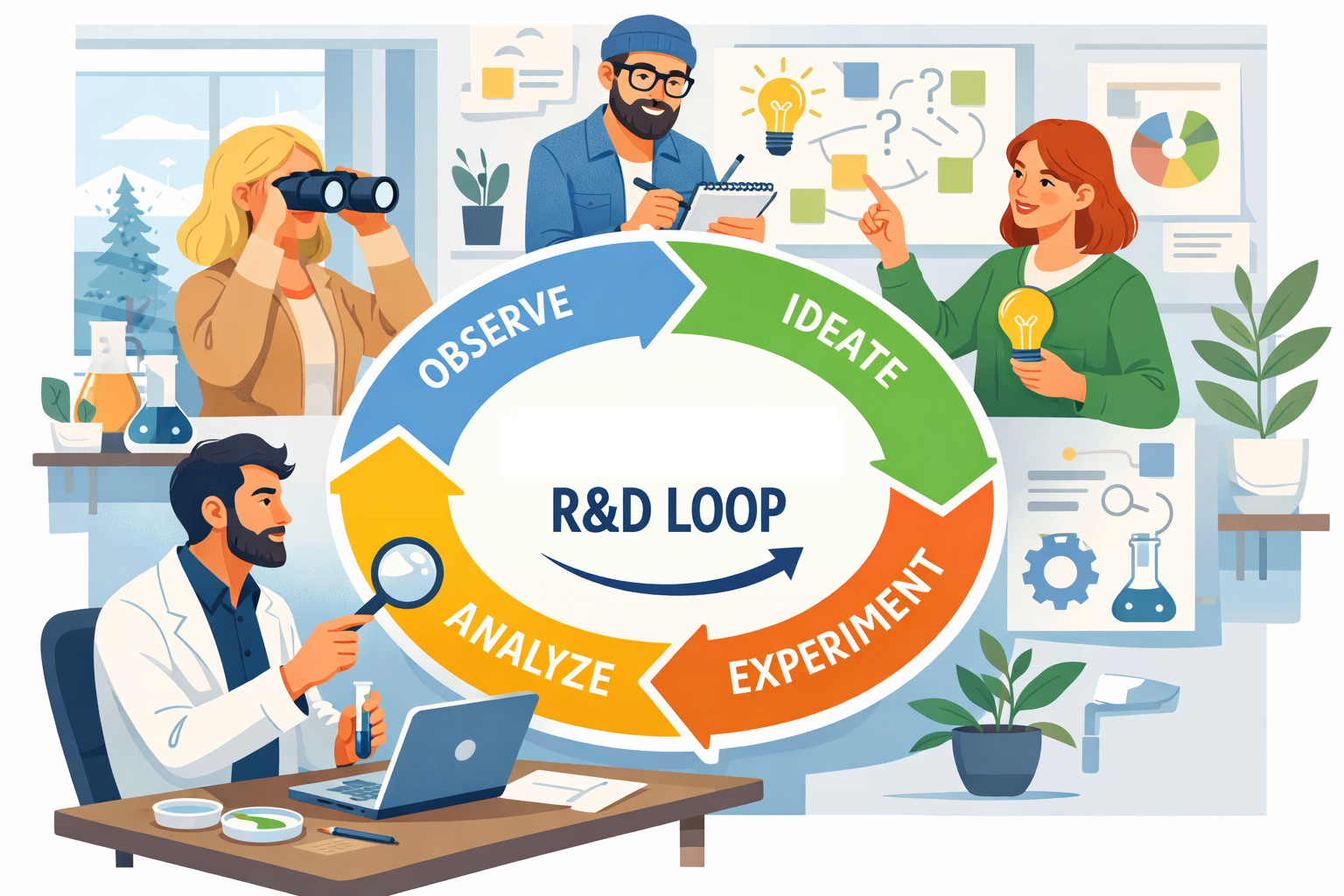
The scientific model is built around a simple but powerful loop: observe, hypothesise, experiment, analyse, and iterate. In product development, the same pattern appears when teams:
- Observe customers, users, and systems to understand problems and context.
- Formulate questions and hypotheses about value, feasibility, and flow.
- Design experiments, prototypes, or models to test those hypotheses.
- Analyse results using clear signals and metrics.
- Iterate based on what they learned, refining both the product and their understanding.
Observation and problem framing come first. Teams study user behaviour, market signals, and system performance to see where real problems, opportunities, and gaps exist. That is the Discover side of the playbook.
From there, they articulate explicit questions and hypotheses. For example: “If we add this interaction, we expect engagement to increase for this user segment,” or “If we change this interface, we expect assembly time to fall below a specific threshold.” Good hypotheses are testable, measurable, and tied to a concrete decision.
Experiments and prototypes follow. Teams build pretotypes, mock-ups, rigs, simulations, or minimum viable products and put them in front of real users or real conditions. They design experiments to isolate variables and see cause and effect — not just to demonstrate what they already believe.
After experiments run, the team analyses results. They compare what actually happened to what they expected, using meaningful metrics such as task completion, failure rates, throughput, or customer behaviour. If a hypothesis is supported, they move forward. If it is not, they adjust or rethink.
The loop continues. Each cycle informs the next set of hypotheses and experiments, keeping development responsive to real-world feedback and changing conditions.
Making it concrete
Models and prototypes as experiments
Throughout development, different kinds of models act as experiments:
- Concept models to explore ideas and check feasibility.
- Proof-of-concept models to show that core principles can work in practice.
- Ergonomic and interaction models to test how users physically and cognitively interact with a product.
- Pre-production validation models that refine the design for manufacturing, service, and real use.
Each model is a structured way to test assumptions: about physics, usability, manufacturability, cost, or user value. By sequencing these models thoughtfully, teams can reduce risk and avoid expensive surprises later.
The benefits of this approach are familiar in Lean PPD:
- Risk is reduced because flaws appear early, when change is cheap.
- Decisions become more evidence-based and less dependent on opinion.
- Innovation cycles speed up because learning happens in small, fast loops.
- Cross-functional collaboration improves because engineers, designers, and business stakeholders share a common learning process.
Scientific thinking as habit
Toyota Kata: scientific thinking as a daily routine
Scientific thinking is most powerful when it becomes a habit, not a special event. Toyota Kata is one way to make that happen.
The Improvement Kata follows a four-step pattern:
This mirrors the scientific method in a practical way. It turns vague improvement work into a sequence of concrete experiments tied to direction and reality.
The Coaching Kata supports this by giving leaders a simple routine of questions to ask: Where are we now? Where are we trying to get to? What is the next step? What did we learn? What will we try next? Through deliberate practice, teams internalise scientific thinking and leaders learn to support it.
“Through deliberate practice, teams internalise scientific thinking. It becomes the way they work, not something they do in a workshop once a quarter.”
Making learning visible
Visual experiment boards
Visual tools make scientific work easier to run and easier to share. A structured experiment board — like the Javelin Board or a team-designed equivalent — helps teams:
- Capture hypotheses about customers, problems, and solutions.
- Identify the riskiest assumptions to address first.
- Plan and prioritise experiments: interviews, pretotypes, simulations, or offers.
- Define clear success criteria and signals before running the experiment.
- Track results and decisions: persevere, pivot, or stop.
The board becomes a shared memory of what has been tried, what was learned, and what remains uncertain. It makes scientific thinking visible and concrete instead of leaving it buried in slides and notes.
Crucially, it creates a shared surface. When engineers, designers, and commercial team members can all see the hypothesis wall, the experiment queue, and the results together, alignment is easier to achieve — and disagreements surface earlier, when they are cheaper to resolve.
The full system
Putting it together in Lean Product Development
When you combine scientific thinking, routines like Toyota Kata, and visual experiment boards with Lean Learning Cycles, you get a coherent system:
- Discover and Strategy define direction, customer problems, and value hypotheses.
- Scientific thinking and Kata provide the pattern for breaking those challenges into target conditions and experiments.
- Experiment boards and learning cycles provide the cadence and visibility for running those experiments.
- Integration events and knowledge capture turn results into decisions and reusable knowledge.
The result is a development system where uncertainty is surfaced early, tested regularly, and reduced systematically. Teams become better at both learning and deciding. Products become more aligned with real user needs and operational reality.
“Uncertainty surfaced early and tested regularly is not a sign of a weak team. It is the mark of a team that knows how to learn its way to a good answer.”
Next steps
Put this into practice
Use this article with teams who are new to scientific thinking in development, or with leaders who want to see how Lean Learning Cycles, experiments, and routines fit together. The next step is to embed scientific thinking into your own system by defining clear target conditions, mapping knowledge gaps and hypotheses, designing experiments across the development stream, and using Lean Learning Cycles to run those experiments with a fixed cadence.
Chapter 6
Validate & Learn
Experiments, prototyping ladders, knowledge-based milestones, and Lean Learning Cycles in practice.
Resource Guide
What Are Lean Learning Cycles?
The structured cadence that makes scientific thinking a repeatable part of development work.
Chapter 5
Design & Flow
How scientific thinking is embedded in set-based design, integration events, and visual management.