The core idea
Why brakes make speed possible
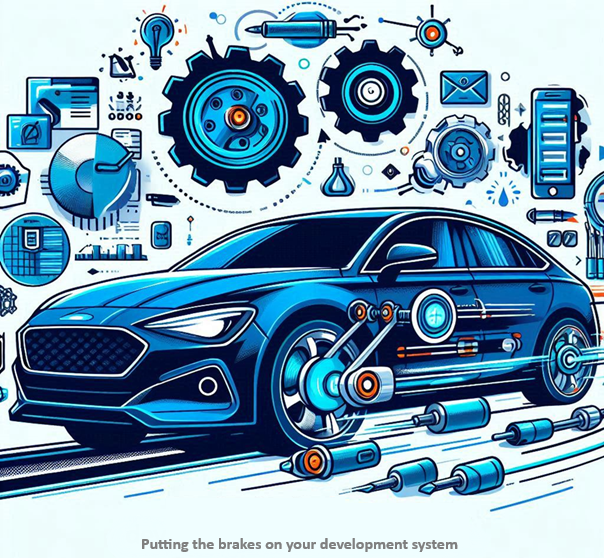
Imagine driving a car without brakes. You would not drive faster. You would drive more cautiously, limit your options, and rely on obstacles to stop you. Brakes do not reduce a car’s potential speed. They make speed usable.
The same logic applies in product development. Teams do not move faster because they avoid checks, evidence, or reflection. They move faster when they have reliable ways to stop, inspect, adjust, and commit with confidence. Without that, development becomes cautious in the wrong places and reckless in the expensive ones.
Many organisations still confuse urgency with progress. They push teams to commit early, close questions quickly, and move past uncertainty before it has been understood. The result is familiar: late design changes, repeated loops, overstretched teams, and products that meet internal plans better than customer reality.
“Without reliable brakes, development becomes cautious in the wrong places and reckless in the expensive ones.”
What actually slows teams down
What the real brakes are in product development
In Lean Product Development, the useful brakes are not approvals for their own sake. They are the disciplines that help teams learn before they commit too much.
These include:
- Fact-based decisions instead of assumption-based decisions.
- Short learning cycles instead of long hidden work periods.
- Prototypes, simulations, and experiments that reveal limits early.
- Integration events that force teams to compare results and surface conflicts.
- Visible knowledge capture so learning is not lost between projects.
These practices do not slow development down. They reduce avoidable uncertainty and prevent the team from accelerating into expensive mistakes.
A team with no good brakes often appears fast in the beginning. Decisions get made quickly. Plans look confident. Work starts everywhere. But because those decisions are weakly informed, speed collapses later under the weight of rework, technical surprises, and organisational friction.
A misunderstood practice
Reflection is not delay
Reflection is often misunderstood as something soft, slow, or optional. In reality, reflection is one of the strongest controls a development system has.
Reflection improves decision-making because it helps teams examine what actually happened, not just what they hoped would happen. It exposes weak assumptions, hidden bias, and patterns that would otherwise repeat. It improves innovation because it creates feedback loops that refine both the product and the way the team works.
It also strengthens empathy. When teams reflect seriously on customer feedback, field observations, and usage data, they become less attached to internal opinions and more grounded in customer reality. Reflection helps teams build products that fit the world they are entering, not the world they imagined.
At team level, reflection improves trust and collaboration. People can raise issues earlier, connect their work more clearly to shared goals, and adapt together when reality changes. At leadership level, it supports resilience, because setbacks become material for learning rather than just signs of failure.
“Setbacks become material for learning rather than just signs of failure — but only if the team has a practice of looking back honestly.”
From principle to practice
Practical brakes that improve speed and control
Useful brakes in development are practical and visible.
Structured reflection sessions help teams review decisions, outcomes, surprises, and process problems before those patterns harden. This can be done through short workshops, guided review questions, or lightweight retrospectives tied to actual product decisions.
Continuous reflection across the lifecycle keeps teams aligned as work moves from discovery to concept, design, integration, launch, and improvement. Instead of saving learning for the end, the team keeps inspecting what is changing and what it means.
Feedback loops are another essential brake. Teams need regular ways to gather customer insight, technical evidence, and operational learning, then use that information to refine designs and plans.
Empirical decision-making matters just as much. Strong teams collect relevant data, use models or simulations where appropriate, and compare options against real constraints instead of internal preference. Benchmarking, early tests, and explicit success criteria all help reduce uncertainty before major commitments are made.
Risk management through early prototyping, testing, and scenario planning lets teams surface technical, customer, or operational risks while options are still open.
Finally, good brakes depend on team dynamics. Open communication, visible knowledge sharing, and a learning-oriented mindset make it easier for teams to absorb setbacks and improve without blame. When teams document lessons and reuse knowledge systematically, the organisation becomes faster over time — not just project by project.
The Lean PPD connection
How this connects to Lean Product Development
In Lean Product & Process Development, these brakes show up as concrete practices: learning cycles, hypothesis-driven experiments, integration events, set-based exploration, visual management, and knowledge capture. The goal is not to slow work down. The goal is to create enough control and visibility that teams can move quickly without paying for it later through avoidable rework.
That is why disciplined learning is one of the best acceleration mechanisms in development. When teams can stop safely, they can move decisively. When they can inspect reality early, they do not need to fear speed. And when they can turn learning into reusable knowledge, every future project starts with better brakes than the last.
“When teams can stop safely, they can move decisively. Disciplined learning is not the opposite of speed — it is the condition for it.”
Next steps
Put this into practice
Use this article when your team is under pressure to “go faster” and needs a better way to explain why evidence, cadence, and reflection improve speed rather than reduce it. The next practical step is to turn that principle into action through Lean Learning Cycles, knowledge-based reviews, and visible experiment planning.
Chapter 6
Validate & Learn
Experiments, prototyping ladders, knowledge-based milestones, and learning cycles in practice.
Resource Guide
What Are Lean Learning Cycles?
The structured method behind the brake: short loops that answer specific questions before decisions are locked in.
Chapter 5
Design & Flow
How LPPD structures design work so that checks, gates, and integration events create flow rather than friction.